


AI is already in use on client work inside Isle of Man law firms - usually without permission - and the fix is not a ban but a clearly drawn line marking what client information may enter which AI tools. Somebody in your firm used AI on client work this week. Not maliciously, and probably not with permission - a fee earner with forty minutes, a sixty-page agreement and a chatbot that produces a decent plain-English summary is a combination that no policy vacuum survives. This is Simplepage's guide, written from Douglas, to where that line sits and how to draw it.
The real starting point is not "should we adopt AI" - your people already answered that - but "where does client information stop". Firms that can answer the second question get the productivity without the exposure. Firms that cannot are running an experiment they did not agree to.
What confidential information is reaching AI tools today?
The typical leaks are mundane, and the pattern is consistent enough to describe without naming anyone - we spend our working days looking at how confidential information reaches public AI tools. These are the shapes it takes:
- An agreement pasted in for a plain-English summary, retention terms unread
- A client's full name, date of birth and source of wealth, inside a prompt asking for a risk narrative
- Board minutes uploaded to draft the action list before a deadline
- The counterparty's name in a deal that has not been announced
- A suspicious activity report, rewritten for tone, unredacted
None of that is malice. All of it is unrecorded, unrecallable, and outside any engagement terms your clients signed. Banning the tools does not fix it either - it moves the same behaviour onto personal phones, where you cannot see it at all.
What do the rules require of an Isle of Man firm?
The rules are functionally the European ones: the Isle of Man applied the GDPR through its own data protection legislation in 2018, so the standard an Island firm answers to covers lawful basis, data minimisation, knowing where personal data goes and being able to account for it. A prompt containing a client's personal details, sent to a consumer AI service on a free account, fails several of those tests at once - and that is before you reach the professional duty of confidentiality, which does not care whether the disclosure was to a person or a model.
The practical implication is narrower than most firms fear. The law does not say "no AI". It says you must know what leaves your control, on what terms, and be able to answer for it. That is a boundary-drawing exercise, and boundary-drawing is something law firms are already good at.
Where should the line sit between AI and client data?
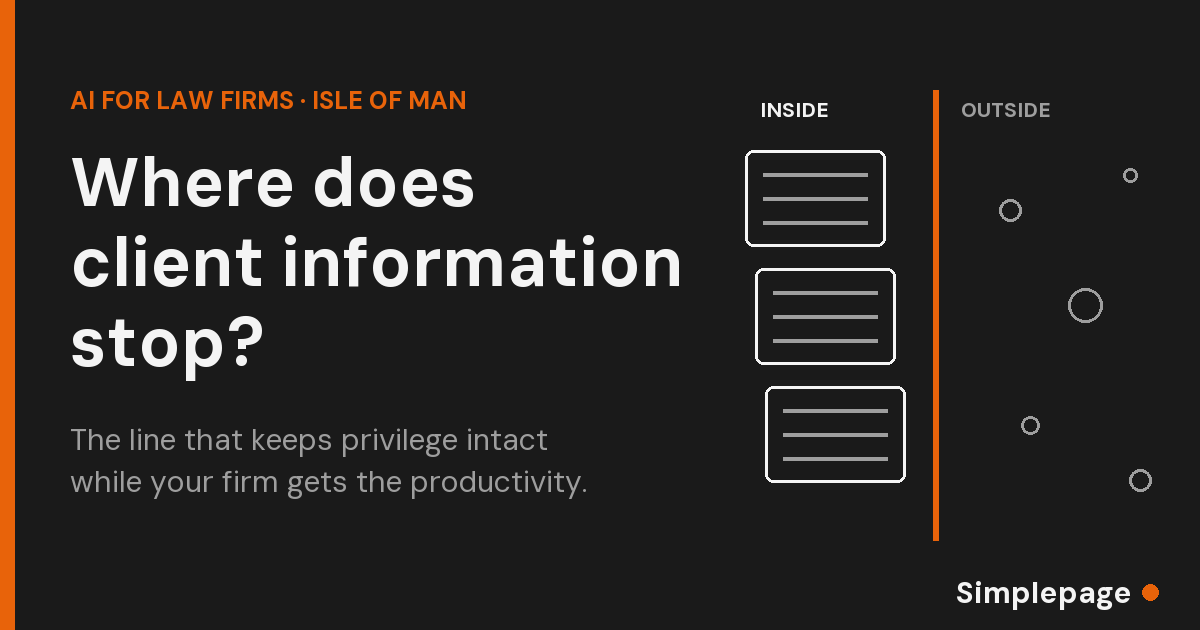
The framework we use with confidentiality-bound firms is one line with two sides.
Outside the line sits everything that was never yours to protect: statute, case law, published guidance, the model's ability to write a clean sentence, public market information. Work built from that material can use any capable AI tool, because nothing confidential is in the exchange.
Inside the line sits everything you hold on trust: client files, matter history, correspondence, the identities in a deal, anything privileged. That material either stays on infrastructure you control, or it does not go near AI at all.
Most AI mistakes in professional firms are not sophisticated failures. They are simply work from the inside of the line being done with tools that live outside it, because nobody had drawn the line where staff could see it.
What is AI genuinely good for in a law practice?
AI's genuine wins in a law practice are real and immediate, provided the work stays on the right side of that line. Summarising and comparing published statute and guidance. First drafts of routine correspondence and internal notes. Turning a precedent structure into a starting draft before any client fact enters the document. Research across public sources that used to soak up paralegal hours. And - with the right infrastructure - searching your own firm's accumulated knowledge with the same ease, without any of it leaving the building.
That last category is where the biggest gains sit for established firms, because your differentiating asset is decades of matter knowledge that public models have never seen. It is also exactly the category that cannot run on a consumer chatbot.
Can staff just use ChatGPT?
The answer on free personal accounts is no, and your policy should say so in writing. Consumer tiers of the main AI services can use what is typed into them, and there is no business agreement behind the processing.
On business and enterprise tiers, with data-processing agreements in place and training switched off, the answer becomes "yes, for work outside the line". That distinction - personal account versus business agreement - is the single cheapest risk reduction available to a firm this month, and most firms have not made it.
What does on-premises AI look like?
For the work inside the line, the answer is infrastructure you own: your firm's knowledge indexed on your own hardware, access-controlled per person and per matter the way your file room already is, every prompt and answer logged, usable through the AI tools your staff already trust - with nothing leaving the premises. That is what we build with our Simple AI vault, and it is described plainly at simplepage.ai.
You do not start there, though. You start by finding out where your firm actually stands.
Where should your firm start this month?
The starting point is three steps, in order. Write the line down - a one-page policy naming what may and may not enter external AI tools, built around how your people actually work. Move anyone using AI for work onto business-tier accounts with a data agreement behind them. And measure where you are: our free AI readiness check is twelve questions, takes about two minutes, and nothing you answer leaves your browser until you choose to send it. You get a scored readiness profile and a plain recommendation, whether or not you ever talk to us.
We are based in Douglas, we work with confidentiality-bound firms on the Island in person, and the first conversation is thirty minutes with no charge and no deck. If the honest answer is that you do not need us yet, that is the answer you will get.
Take the readiness check or read more about the consultancy at simplepage.ai.