


Cloud bills are where money goes to hide. They arrive every month, they are rarely a round number, and almost nobody opens them up to ask whether every line is earning its keep. The setup was done once, it worked, and everyone moved on. The meter just keeps running.
We talk a lot about using AI to build things faster. This is a story about using it to do the boring, valuable job nobody gets around to: auditing cloud spending. One of the partner agencies we do development work for let us point our AI process at their hosting, and in an afternoon it found a charge they had no reason to be paying.
What we actually did
We added a tool that lets our AI assistant read their Microsoft Azure account, where a lot of their hosting lives. To be clear, this was read-only. The assistant could look at everything and change nothing. Then we gave it a simple brief: review the setup, tell us where the money is going, and flag anything that looks higher than it should be.
It worked through the account the way a careful analyst would, except it did not get bored. It listed every service, grouped the costs, and within minutes pointed at one line that stood out. A single service was eating more than half of their subscription's entire monthly bill, around £52 a month, far more than anything comparable next to it.
So we asked the obvious question: why is that one so expensive? And it went digging.
The answer was a setting nobody had questioned
The service was running on Windows. That sounds harmless, but Windows hosting carries a built-in software licence fee baked into the price. The exact same service running on Linux, which is free to license, costs about a fifth as much.
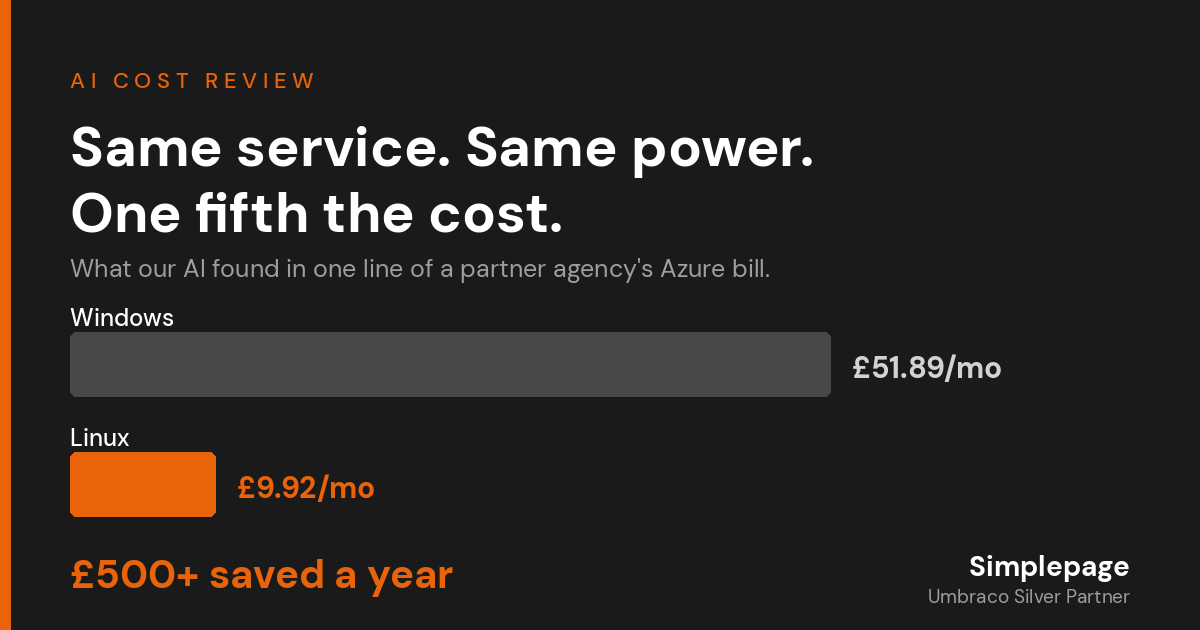
We did not have to take that on faith. Another service in the same account, doing a similar job, was already running on Linux. The AI pulled its real cost from the billing data: £9.92 a month, against £51.89 for the one on Windows. Same size, same power, same region. The only difference was the licence they were paying for and getting nothing extra in return.
Why was it on Windows in the first place? Because that was the default when it was first set up, and no one ever went back to ask the question. That is the whole point. This was not a mistake anyone made, it was a default nobody revisited.
The numbers
Moving that service to Linux took about £42 a month off the bill. On one small service, that is more than £500 a year. Go a step further and move it to a setup that only charges when it is actually doing work, and the saving climbs closer to £600 a year.
The fix itself was low risk. Because the code was already built to run anywhere, there was no rewrite involved, just a move. The database and stored files stayed exactly where they were. Only the thing they were overpaying for changed.
And here is the part worth sitting with. The whole investigation took about three to four hours. A person could have done it, but a person never would have, because it means reading line by line through an opaque bill, knowing what each setting costs, and chasing down the one number that looks odd. It is precisely the kind of patient, unglamorous work that AI is genuinely good at, and that gets skipped when it is left to a human with a full diary.
Why this matters for you
Most businesses are paying for something like this right now and have no idea. Cloud bills are deliberately hard to read, the settings that drive the cost are buried, and there is usually no single person whose job is to question them. The waste is almost never dramatic. It is a sensible-looking default, set once, quietly costing you for years.
The reason we are sharing this is not to show off a clever trick. It is to make a simple point about how we use AI in practice, away from the hype. We do not use it to write breathless blog posts about the future. We use it to find real money, answer real questions, and do the careful work that would otherwise never get done. We ran it against a real, live account with real bills before recommending it more widely, which is the only honest way to know it works.
If you are paying a monthly hosting or cloud bill you do not fully understand, there is a good chance the same kind of saving is sitting in it. We can run the same review on your setup, read-only, no disruption, and tell you in plain English where your money is going and what is safe to trim. It usually pays for itself several times over in the first month.
If that sounds useful, get in touch. We would rather find the money for you than watch you keep paying for a setting nobody questioned.
